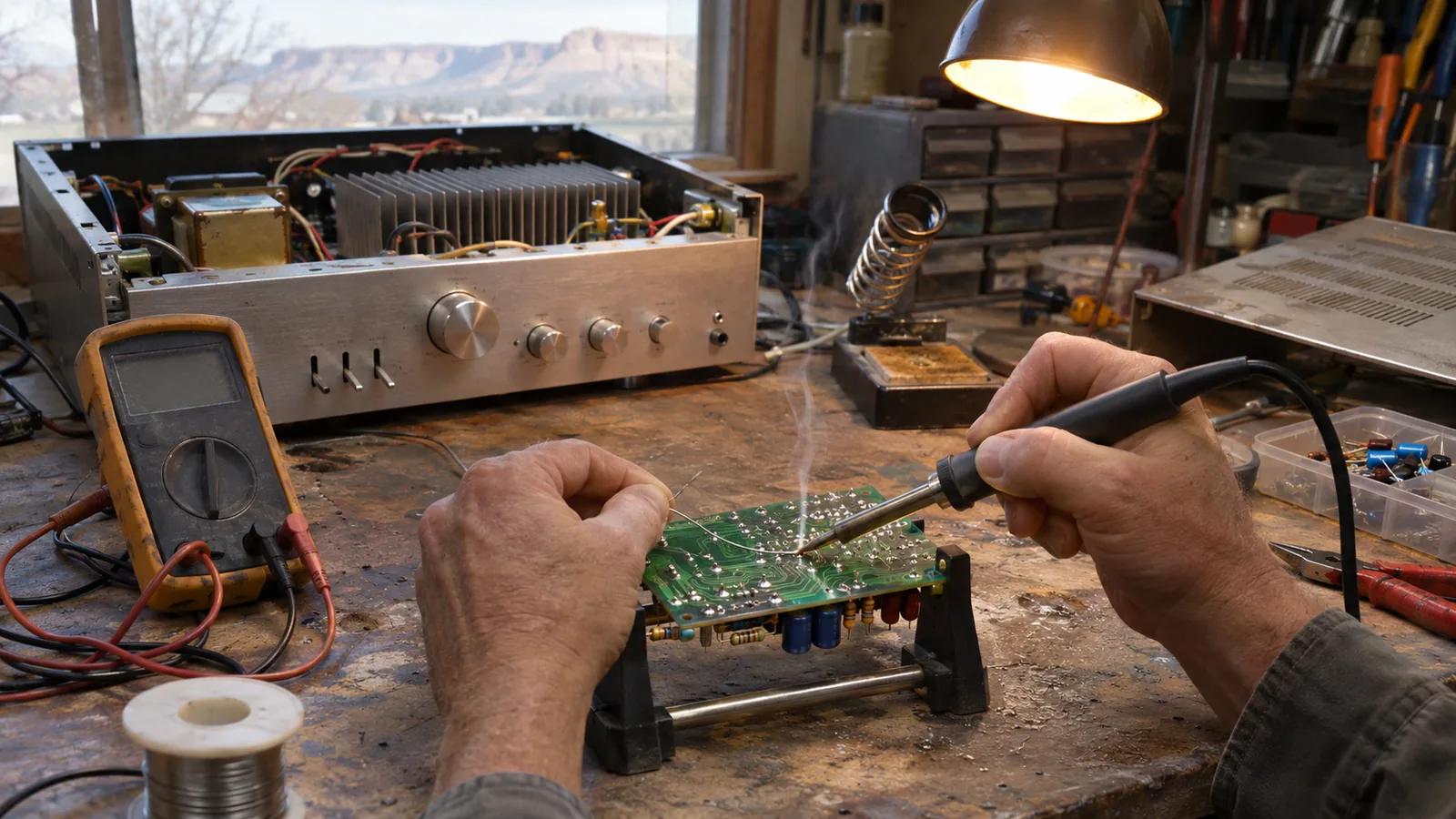
Electronics repair in Grand Junction usually costs less than replacing the item and keeps working gear out of the landfill. GJ Tech Help fixes audio equipment, cameras, wireless mics, DJ gear, computers, radios and cables for customers in Grand Junction, Fruita and Palisade, and tells you the price before any work starts, so you can decide whether a repair makes sense.
What electronics repair in Grand Junction covers
Most electronics fail in a small number of places: the power supply, a connector that has been plugged in thousands of times, a cracked solder joint, or a single part that wore out. Those are fixable. The device around them is usually fine.
The work GJ Tech Help takes on includes:
- Audio gear: amplifiers, receivers, powered speakers, mixers and audio interfaces.
- Production equipment: cameras, field kits, wireless mic systems, lavalier and handheld mics. See camera, mic and DJ equipment repair for the full list.
- DJ equipment: CDJs, controllers and DJ mixers with dead channels, noisy faders or broken jacks.
- Computers: slow or crashing PCs and laptops, failed drives and setup problems, covered on the computer help and IT support page.
- Radios: ham and two-way radios, antennas and coax, covered on the ham radio antenna installation page.
- Cables and connectors: XLR, quarter-inch, RCA, coax and power leads rebuilt or replaced.
If a plastic part broke and nobody sells a replacement, custom 3D printing can often make one, which turns a lot of "not worth fixing" jobs into easy repairs.
Why a local repair shop matters on the Western Slope
Grand Junction is about 240 miles from Denver by I-70. For a lot of specialized gear, the usual alternative to a local repair is boxing it up and shipping it to a service center, then waiting. For a musician with a gig on Saturday, a DJ with a wedding booked, or a church that streams every Sunday, the real cost of a broken piece is the time without it. A repair across town, with the item back in days rather than weeks, often matters more than the bill itself. It also means you can talk to the person doing the work, ask what failed, and get advice on keeping it from happening again.
Signs your electronics can be repaired
These symptoms almost always point to a fault a technician can find and fix:
- It went dead all at once, often after a power outage or storm.
- One channel, one input or one speaker is silent while the rest work.
- It crackles, hums or cuts out when you touch a knob, fader or cable.
- A jack is loose, or sound only comes through when the plug is held at an angle.
- It powers on, then shuts off after a few minutes as it warms up.
- A display or indicator light is dark, but the unit still makes sound or responds.
Physical damage is harder to judge. A dropped camera or a mixer with a drink spilled into it may be fine after cleaning, or the damage may run deep. A look inside settles the question quickly, which is why the first step is always an honest assessment rather than a guess over the phone.
Repair, replace or recycle?
The right answer depends on what the item is worth to you, how old it is, and whether parts exist. This table is a starting point.
| Option | Best for | Watch out for |
|---|---|---|
| Local repair | Quality gear with a single fault, pro audio and production equipment, anything you rely on for work | Very cheap items where the repair costs more than a new one |
| Manufacturer mail-in repair | Items still under warranty | Shipping both ways, weeks without the gear, flat-rate fees on out-of-warranty units |
| Replace | Budget electronics, devices too old to run current software | Throwing out a good device for one cheap part |
| Recycle | Items with no repair path and no resale value | Colorado law keeps electronics out of the trash, so it has to go to a proper e-waste drop-off |
A good rule: if you would buy the same model again, it is probably worth repairing. If you were already planning to upgrade, the repair price helps you decide whether now is the time.
Colorado's right-to-repair law and what it changes
Colorado's Consumer Right to Repair Digital Electronic Equipment law (HB24-1121) was signed on May 28, 2024 and took effect on January 1, 2026. It requires manufacturers to make parts, tools and documentation available, on request, to owners and independent repair providers so electronics can be diagnosed, maintained and repaired outside the manufacturer's own service network.
The law also limits "parts pairing," where software refuses a working replacement part because it was not installed by the manufacturer. Under HB24-1121, a manufacturer cannot use parts pairing to block a replacement part, reduce performance, or trigger misleading warnings about an unrecognized part.
Two limits matter for local customers. First, the rules cover equipment manufactured and sold or first used in Colorado on or after July 1, 2021, so older gear is not included. Second, some categories are excluded, including motor vehicles, most medical devices and video game consoles. For everything else made in the last few years, an independent shop like GJ Tech Help has a clearer path to the parts and service information a repair needs.
When electronics can't be fixed: e-waste in Mesa County
Some things are past saving. When that happens, they still cannot go in the trash. The Colorado Department of Public Health and Environment says residents can no longer dispose of household electronics in their trash, and landfills and haulers must treat waste electronics as prohibited.
In Mesa County, the place to take them is the county's Hazardous Waste Collection Facility. As of November 2026 the county lists it at 3071 US-50 in Grand Junction, open Wednesday through Saturday from 8 a.m. to 4:15 p.m. It takes electronics such as computers, stereos, TVs and game consoles for $0.80 per pound, with a one-pound minimum. The county renewed its e-waste recycling contract for 2026 and says the facility receives more than 240,000 pounds of electronic waste a year.
Recycling still beats the landfill. The EPA notes that recycling one million cell phones can recover about 35,000 pounds of copper, 772 pounds of silver and 75 pounds of gold, according to its electronics donation and recycling guidance. A repair that keeps a device in use for a few more years is better still, because nothing has to be mined or manufactured to replace it.
How a repair works with GJ Tech Help
GJ Tech Help is run by Cody Kennerknecht, who spent 13 years in live television as a newscast director and broadcast engineer before starting the business. You can read more about Cody's background. A repair goes like this:
- Call or text 970-250-6613. Describe the problem and send a photo of the item and its model label if you can.
- Get a clear price. Cody looks at the item, on-site or at his bench, and tells you what it will cost before any work starts. Customers 55 and older get a 15% discount.
- The repair. Bench work for most electronics; on-site for installed systems such as church livestream and AV systems.
- Plain-English rundown. You get an explanation of what failed, what was replaced, and how to avoid the same problem.
Work is by appointment, and the service area covers Grand Junction, Fruita, Palisade, Clifton, Orchard Mesa, the Redlands, Loma and Whitewater, with farther parts of the Western Slope by arrangement.
Before you bring it in
- Write down exactly what happens and when it started. "Left channel cuts out when the volume is past halfway" is far more useful than "it's broken."
- Bring the power supply, remote and any cables that are part of the problem.
- For computers and cameras, back up anything you can still reach. Failing drives and memory cards can get worse with use.
- Note the make and model from the label on the back or bottom.
- Stop using anything that smells hot or shows smoke. Unplug it and leave it unplugged.
Ready to find out whether your gear can be saved? Contact GJ Tech Help to set up a time.
Common questions
Is it worth repairing electronics instead of replacing them?
Often, yes. Most failures come from one part such as a power supply, connector or worn component, and fixing that costs less than a new unit. GJ Tech Help gives you the price first so you can compare. Customers 55 and older get a 15% discount.
What kinds of electronics does GJ Tech Help repair?
Audio gear, cameras, wireless mics, DJ equipment, mixers, computers, ham and two-way radios, antennas and cables. If you are not sure, call or text 970-250-6613 and ask.
Does Colorado have a right-to-repair law for electronics?
Yes. HB24-1121 took effect January 1, 2026. It requires manufacturers to provide parts, tools and documentation to owners and independent repair shops for most digital electronics sold in Colorado since July 1, 2021.
Where can I recycle electronics in Grand Junction?
Mesa County's Hazardous Waste Collection Facility at 3071 US-50 accepts electronics for $0.80 per pound, Wednesday through Saturday, as of November 2026. Colorado law keeps electronics out of household trash.
Do you serve Fruita and Palisade?
Yes. GJ Tech Help works across Mesa County, including Fruita, Palisade, Clifton, Orchard Mesa, the Redlands, Loma and Whitewater, by appointment.
About the technician
GJ Tech Help is run by Cody Kennerknecht: 13 years in live television as a newscast director and broadcast engineer, IT and cybersecurity lead for Charity Safaris, and FCC-licensed amateur radio operator K6SBR. More about Cody.